
SEED TO STITCH
Story of my favourite kurta
Kishore Shah, Origins Story
Khadi London
Part 1
I have a favourite kurta. Or rather a cross between a kurta and a T-shirt. It is made with organic cotton fabric, hand spun and handwoven. The fabric is soft and textured. Slubs add depth.
I am familiar with the farm and village where the cotton was grown, the place where the cotton was spun and woven and know the designer of the kurta, and about the tailor who stitched it. The kurta has a story which is worth listening to.
One strand of the story begins with Samat bhai and Gauri ben, a husband and wife team from Dharai in the Rajkot district of Gujarat, India. They had decided to go against the flow, grow organic cotton on their farm. They sowed the seeds, watched them grow into saplings and eventually reaped a decent harvest.
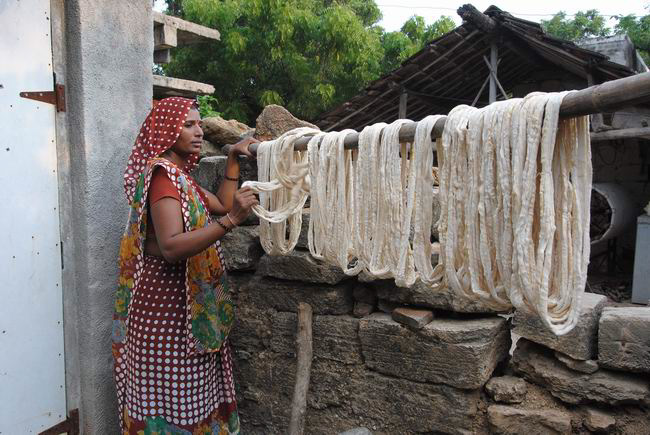
Udyog Bharati, a khadi cooperative nearby bought the cotton from them at a premium price and processed it locally. Ginning, carding, roving, spinning, and weaving, the whole lot.
I discovered the fabric while searching for organic khadi about a decade ago. It was difficult to locate a supplier of organic khadi back then. The search led me to Weaver Bird and its founder Medha Shah.
Medha is a granddaughter of Jagdish Shah. I met Jagdish bhai in Bihar in eastern India in the early 1970’s. I was a volunteer with Sarvodaya, a movement for village autonomy. I was part of a national campaign. Jagdish bhai and his with fellow Sarvodaya activists from Gujarat spent a month and sometimes two months every year to be a part of the campaign.
During his lifetime Jagdish bhai had visited many villages in Gujarat as a part of the Sarvodaya movement with a simple message, to lead with a corporative way of life which would take care of the needs of everyone in the village. Dharai was one of those villages.
The movement ebbed in the mid 1970s when his son Kapil was growing up. Kapil graduated as an agricultural scientist. But he had inherited the mantle of a rebel. He went against the flow and started a movement for organic farming in Gujarat. His work extended to Dharai which decided to transit to organic farming.
Kapil’s daughter, Medha, trained as a fashion designer. She had her own thoughts about how to be a part of the profession without compromising on the values of her grandparents and parents.
After graduation she decided to spend time in Dharai, talking to farmers to understand if they would be willing to grow cotton organically. She explored the idea of paying a premium price for the cotton to help with the transition. A premium of 30% on the market price seemed about right. Samat bhai and Gauri ben were the first to join the fray.
Medha connected the farmers with Chandrakant Patel of Udyog Bharati, a khadi institute established about a hundred years ago. With a shorter staple, spinning and weaving would be difficult. The spinners and weavers were promised training and premium of 10% on their wages. Medha started her own brand, Weaver Bird, to add value to the fabrics with the hope of making it a viable venture.
The next challenge was finding a market for organic khadi fabrics and clothes. Customers in India were not yet willing to give a higher price for organic khadi. In western countries where there was a greater awareness about and demand for organic cotton, only a few designers knew about khadi.
To overcome the uncertainty, Weaver Bird asked customers to place their orders for fabrics before the sowing started. A lead time of about nine months! I remember placing an order for 150 meters.
The stock stayed with us for months as we couldn’t find the buyers. That changed when Henrietta Adam and Sareeka Linton of Henri London visited the farmers and Udyog Bharti as part of a trip to get an experience of the supply chains. Impressed by what they saw they became brand ambassadors for handmade fabrics of India, especially from the places they had visited. Organic khadi from Udyog Bharti was one of the fabrics they booted for and has since been one of our popular fabrics with ethically conscious design brands.
Part 2
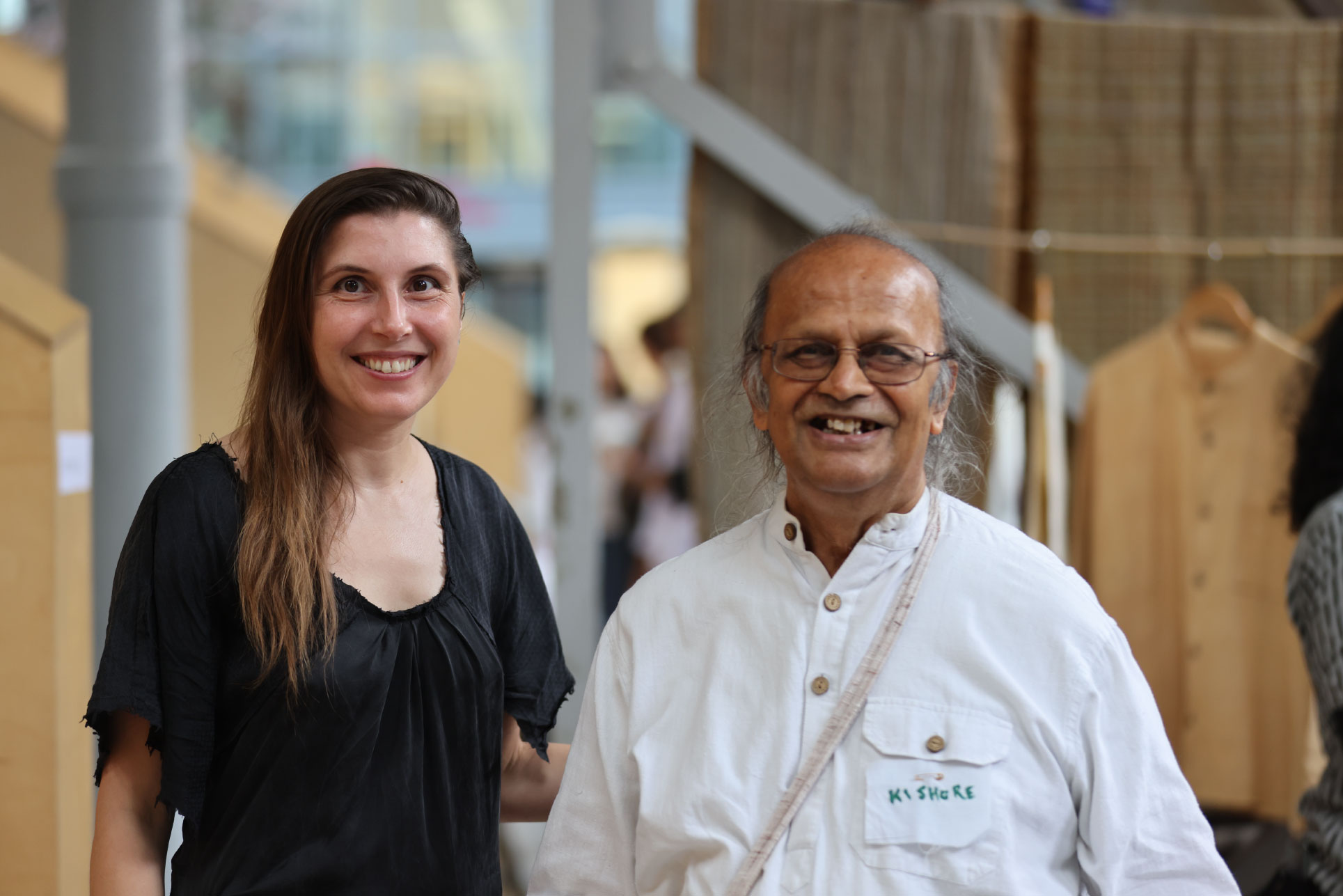
I remember the first meeting with Henrietta. We were both attending a workshop for new businesses. Henrietta had just graduated from the London School of Fashion and decided to go down the self- employment route instead of searching for a job. Mine was more like a post retirement hobby, doing something to give back to the Gandhian movement that I had been a part of.
Henrietta was looking for organic fabrics that would be suitable for an ethical brand and had an aesthetic look. I had a bag full of samples – khadi swatches. And thus started our business collaboration.
Henrietta chose organic khadi shirting for her first collection of women’s shirts. Customer response was positive. It motivated her to source a wider range of organic khadi and handwoven fabrics. Henrietta was keen to visit India and get a first hand experience of the value chain. Sareeka who was working with her at the time shared her enthusiasm.
They decided to take a couple of weeks off after the busy Christmas season to visit India. We connected them to our suppliers and to Andy of Fresh Eyes: People to People Travel, a not for profit tourism company to help plan the itinerary and with the logistics. Henrietta and Sareeka landed in Mumbai early in the January of 2018.
There was no time to waste. After a couple of days in Mumbai, they took the train to Bhuj in the desert district of Kutch to visit Khamir, the home of kala cotton fabrics. Visiting farmers, spinners and weavers. Henrietta and Sareeka were vowed by the experience.
Dharai and Udyog Bharti were the next stops. Kapil and Medha accompanied them. It was here that they could see the benefits of the participatory certification system which Jatan Trust had introduced and of how the partnership between the farmers of Dharai, Weaver Bird and Udyog Bharati worked.
The journey continued. The destination was Rajasthan which included a trip to Tonk to meet Rahim bhai, a local traditional tailor. Henrietta has a keen interest in pattern making and tailoring. Suddenly the language barrier disappeared. Sketches and scissors did the talking. And boom, they had a shirt design ready within an hour or so. Not exactly a shirt, it was a cross between a kurta and a T shirt.
Rahim bhai already had my measurements and used the design to make three shirts for me. A bleached organic khadi and a unbleached slub khadi from Udyog Bharti and a indigo diamond pattern handwoven kala cotton fabric from Khamir. Of the three, the slub is my favourite, often end up wearing it on special occasions.
Postscript: Udyog Bharti has seen an overwhelming demand for organic khadi and has diversified its supply base for organic cotton. Henrietta has moved on, ‘from selling fully made clothes to selling patterns and online workshops for people to sew their own clothes at home’, under the brand name The Modern Sewing Company.

